

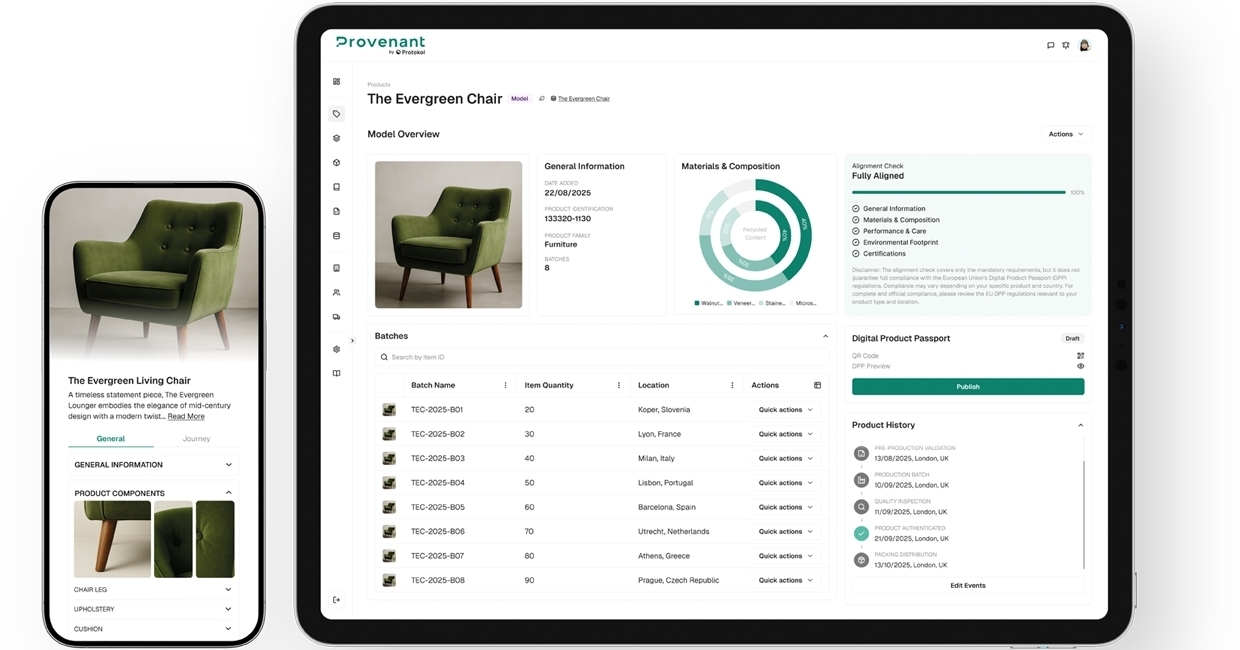
Images by Provenant, Furniture DPP
Expectations around circularity in the furniture industry are rapidly evolving – from a design ambition or brand value into a business requirement. This shift is being driven by several converging forces: tightening EU regulations, increased investor scrutiny around sustainability credentials, and consumers demanding greater transparency about how furniture is made, sourced, and disposed of at end-of-life.
A 2025 Morgan Stanley report found that 88% of investors express interest in sustainable investments, while 54% of consumers now say they’re willing to pay a premium for sustainable products.
For furniture manufacturers and brands, this shift is becoming tangible through regulation. The first delegated act under the Ecodesign for Sustainable Products Regulation (ESPR) is expected in 2026, initially focusing on the Iron & Steel industry. However, its implications extend directly to furniture, where steel, aluminium, wood, textiles, and composite materials are central to product design.
The furniture industry will need to implement DPPs under this regulation and will have its own delegated act, expected to come into force in 2028, with businesses typically given up to 18 months after adoption to comply with the requirements. The regulation will specify the precise sustainability data required in Digital Product Passports (DPPs) for furniture products, representing a significant step toward product-level transparency.
This signals a broader transition toward verified sustainability – where claims about durability, recyclability, repairability, and material sourcing must be supported by data. For furniture businesses, circularity can no longer live solely in sustainability reports or marketing narratives. Instead, it must be embedded into how products are designed, manufactured, specified, and sold.

As the industry prepares for the year ahead, there are three key considerations furniture businesses should prioritise.
1. Treat sustainability like a core product metric, not a marketing layer: In furniture production, sustainability has often been positioned as a brand differentiator: recycled packaging, carbonneutral pledges, or limited “eco” product lines. That won’t be enough going forward. Regulators and partners now expect hard metrics, carbon footprints, material compositions and repair scores to be tracked with the same rigour as cost, performance, or reliability.
If a device is marketed as recyclable, repairable, or low-impact, manufacturers will need to consider internal systems that can prove it. In practice, that means sustainability data becoming embedded in product design, sourcing, and manufacturing decisions, not added after the fact.
2. Build proof into every claim as the default process: Moving forward in the new era of verified sustainability, every claim made about circularity or environmental performance needs to have proof behind it.
To achieve this, furniture businesses will have to increasingly strengthen their underlying data infrastructure, including understanding where product and lifecycle data currently lives, the collection method, and how reliable it is.
For the furniture businesses that are built on fragmented systems and data collection, moving into an integrated and robust process that considers the full product lifestyle is becoming nonnegotiable. This sense of urgency is heightened by the array of sustainabilityrelated regulations on the horizon for businesses throughout 2026, including the ESPR and its integration of DPPs. However, preparing for these can provide an opportunity to build a body of proof for businesses in one overarching action.
DPPs can act as a structured, digital record of a product’s key attributes and lifecycle, hosting information from across the entire value chain. Therefore, a business with robust DPP-ready data will be far better equipped to showcase compliance, respond rapidly to regulatory requests, and provide credible information to its customers and partners.
This year, the priority should be to clarify data sources to improve data integrity, increase data quality, and identify where there are gaps. Businesses able to trust their data will find it much easier to adapt to evolving regulations, especially as the pressure to prove their external environmental claims grows.
3. The main audiences that expect verifiable sustainability information in the furniture space: Sustainability data isn’t just a requirement from regulators anymore. Other businesses, as well as end users, need to be considered. Many businesses in the supply chain have their own data collection obligations to fulfil– whether these are regulatory or a necessary step towards the best position for tenders and contracts. With this in mind, they need more information on carbon emissions and material composition from partners.
Running alongside this is the reception from end users. Customers who are constantly faced with unsubstantiated sustainability claims will begin to expect to see verified claims backed with trusted data. Strong relationships will then be forged with the businesses that provide concrete, understandable information about the longevity of products, how easily they can be repaired, and how to handle them correctly when they come to the end of their life.
Regulators will want to see that claims are consistent across all channels, that data can be traced back to their source, and that businesses have systems in place to keep this process running over time. Businesses that already have a clear view of their lifecycle data, and a transparent way of presenting it, will find the compliance aspect easier.
Expectations of circularity have had a huge growth, and in 2026, we can expect to see an even more demanding regulatory and market environment. Furniture businesses that prioritise sustainability as a core operational priority will be in the best position to navigate this shift.