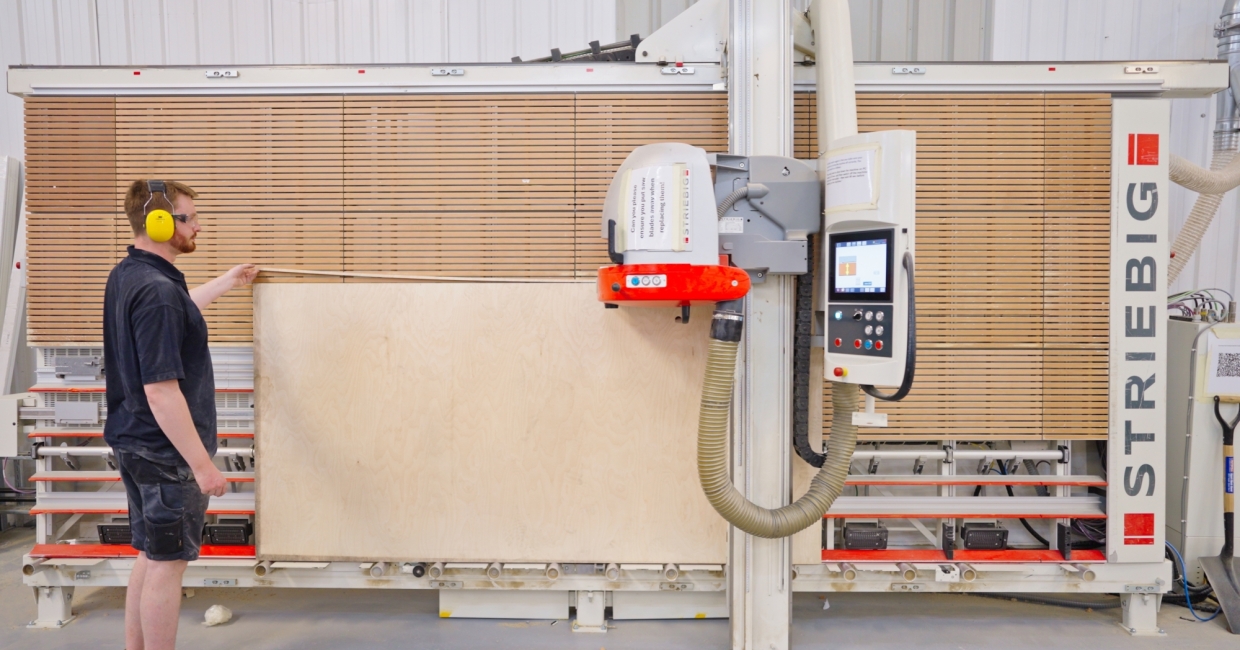
TM Machinery helped Michael Pepper Joinery support a major period of growth with the supply of a Striebig Control 5216 vertical panel saw.
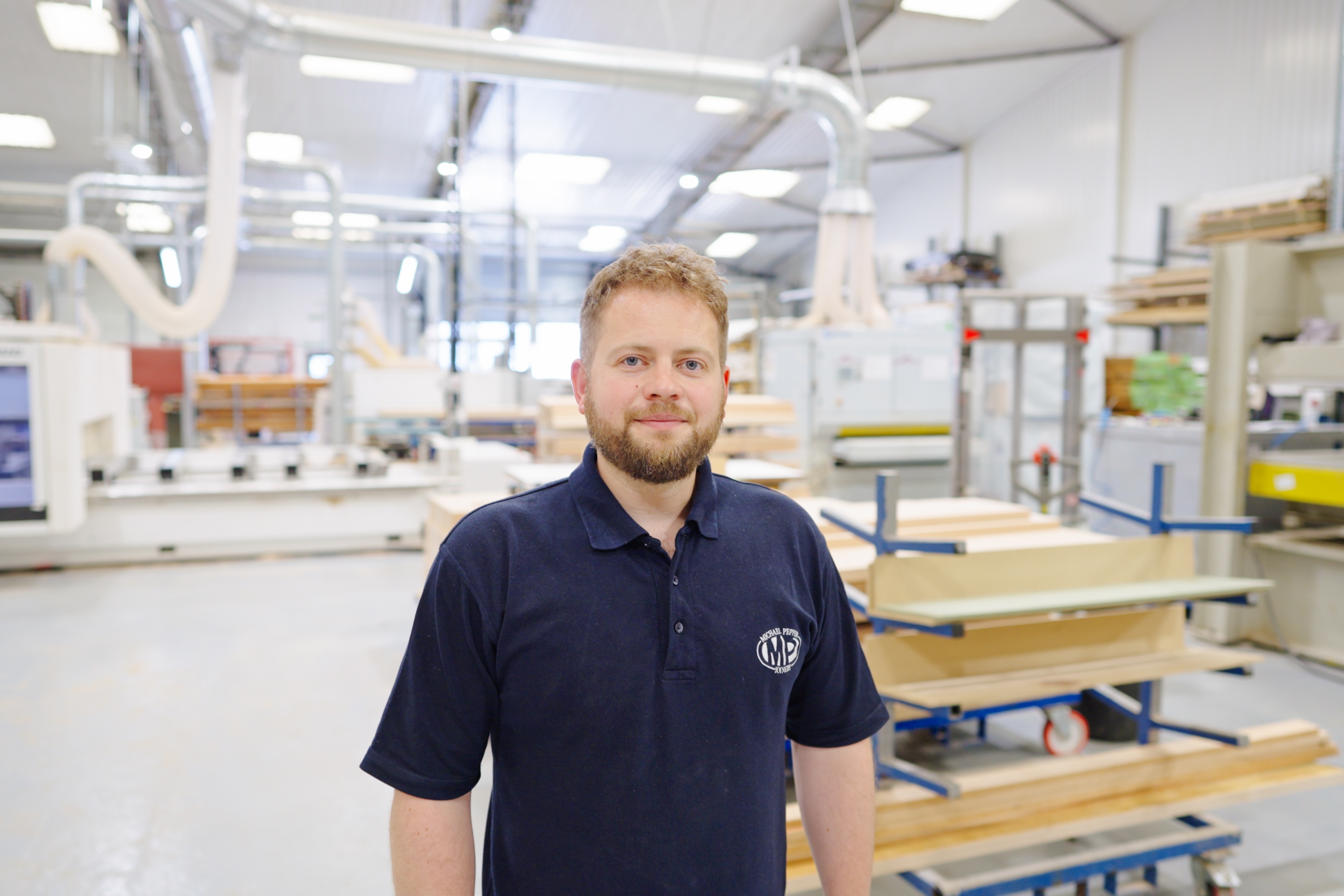
From bespoke joinery to high-volume fire door production, Michael Pepper Joinery has undergone a significant transformation. The Derby-based business now employs around 40 people, operates from a 27,000 sq.ft. factory and has grown turnover by more than three and a half times in five years. A Striebig vertical panel saw played a key role in making that possible.
The business was founded by Michael Pepper, a joiner who built a company with a reputation for high quality, complex, bespoke work. The more challenging the project, the better. From spiral staircases and conservation windows to the games and spinning wheel for Bruce’s Price Is Right, “Anything that wasn’t the norm would get my dad going,” says Managing Director, Josh Pepper, who took over from his father around five years ago.
Josh wanted to take the company in a new direction, growing turnover and supporting customers with larger projects. To meet those goals, the business became more focused, with fire doors and fire door sets becoming its core specialism. The introduction of costing and production software for bespoke orders helped standardise processes while maintaining the flexibility required for customer-specific products.
The approach was simple: build on what worked, invest where it mattered and create the capacity to grow.
The foundations were already in place — an experienced team, with some employees having been with the company for more than 20 years, and a Striebig wall saw that had supported the business for many years. For Josh, the aim was always to honour the company that it was and bring people along for the journey. He credits the support of the team, who have embraced the changes and growth of the business, as an important part of that success.
But growth at pace brought its own challenges. Initially, increasing output could be accommodated within the existing business. With experienced staff and available capacity already in place, the focus was on securing more of the type of work the company wanted to undertake.
As enquiries and order sizes increased, attention turned to ensuring the factory could support future growth.
“As you’ve grown 20-30%, you’ve just really absorbed that within your team, but when you start looking at doubling the size of what you’re trying to do, you need to really review the infrastructure that you’ve got,” says Josh.
The primary cutting saw was an older Striebig wall saw. “It was a great machine. It did its job.” The issue was not performance, but age. As production volumes increased, maintaining reliability became increasingly important. For Josh, the focus was not on changing the process but modernising a proven one.
“We’ve got something that worked and we just wanted the same thing again, but a newer version. To go with Striebig was quite an easy decision for us.”
With the decision made, attention turned to the specification. Leicester-based TM Machinery worked with the business to develop the final machine configuration, resulting in a Striebig Control 5216 equipped with Electronic Positioning System (EPS) on both axes and a 4SB bottom trim unit. The project was completed with a smooth delivery and installation process.
The upgrade quickly proved its value. One of the most useful features has been the machine’s automated positioning system. “The operator doesn’t have to keep walking away to set stuff. They enter the sizes, the machine sets itself, it speeds things up and it’s much more accurate,” says Josh.
One of the key benefits, according to Josh, is the system’s ability to re-reference itself if knocked. Unlike a manual stop, which can introduce small variations across a production run, the machine automatically resets itself to the correct position. “We definitely noticed an improvement in our dimensional accuracy as a result of that”.
Looking back, there is one specification choice Josh would reconsider. The previous machine had a scoring unit, and, in hindsight, it was a feature he missed more than expected. “It comes with quite a lot of advantages as far as material finish goes. If I could go back, I probably would have purchased the scoring unit for the machine.”
For door production at volume, the vertical panel saw format proved particularly suited to the work. Josh is quick to point out that table saws are great machines and have an important place in many factories and bespoke joinery workshops. For Michael Pepper Joinery, however, the handling and workflow advantages of a vertical panel saw proved better suited to processing large volumes of rectangular panels.
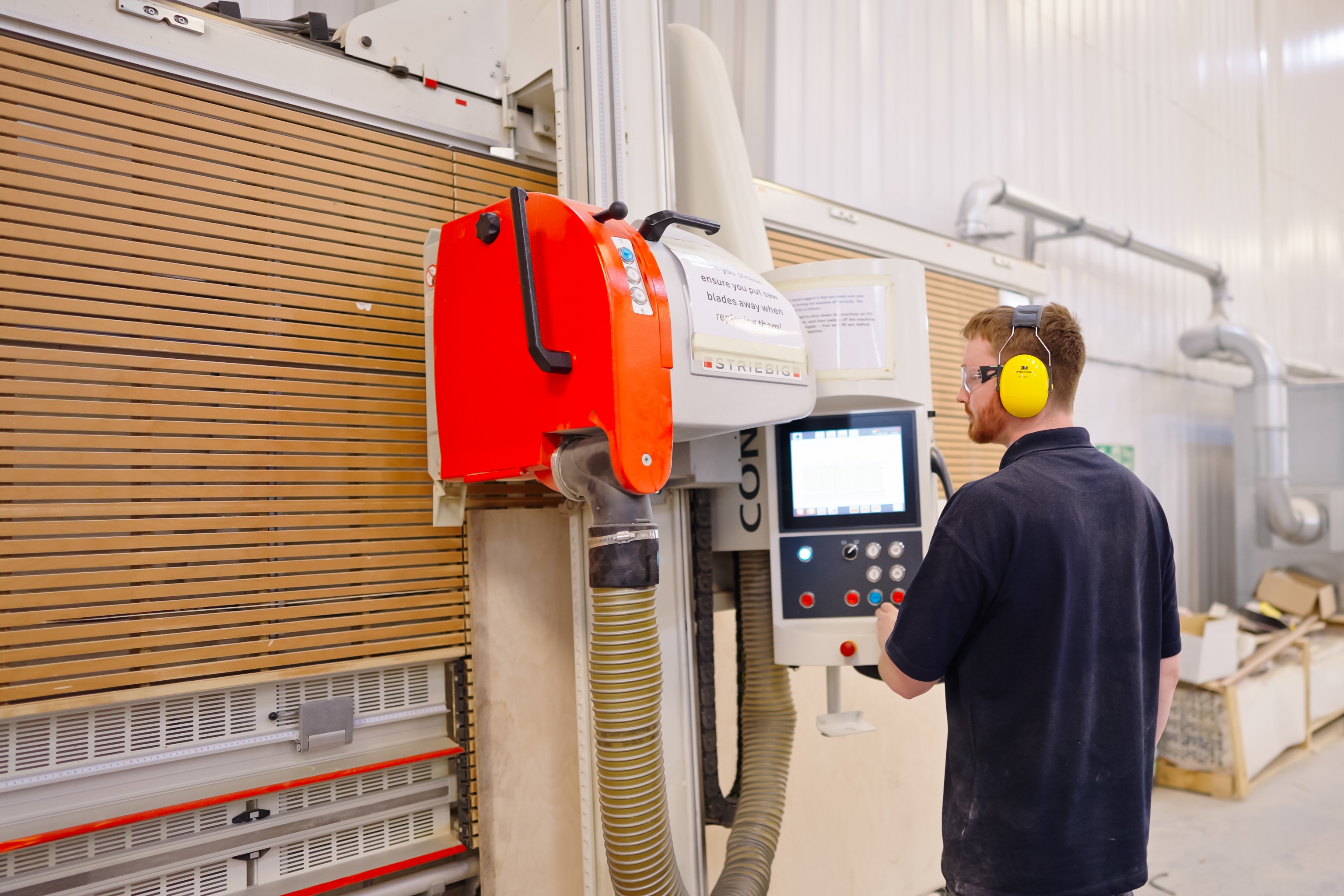
“The fundamental difference between the two is — on one, the saw moves, and on the other, the panel moves. If you’ve got a panel that weighs 50 to 100 kilos, do you really want to be moving that panel lots of times, or do you want the saw to take the work out for you? We had a table saw and got rid of it.
“The Striebig really just unrestricted us,” Josh says. “The new machine basically removed that limiting factor and was able to keep up with the demand.”
That period marked a significant step change for the business. Cutting volumes have risen from around 40 doors a week to 140, turnover has increased by more than three and a half times, and the team has grown from 17 to 40 people.
Today, the business is process-driven and capable of significantly higher output. The new factory is three times the size of the previous premises, providing room for two CNC machines, a new edge bander, beam saw and a dedicated finishing facility capable of producing fully finished door sets across a range of colours, laminates and veneers. The ambition now is to double turnover and output again.
For Michael Pepper Joinery, the Striebig became a core part of the company’s growth. With virtually every product cut to customer-specific dimensions, reliable and efficient cutting capacity was essential to supporting increasing volumes while maintaining the accuracy required for bespoke production.
Although no longer the primary cutting machine, the Striebig remains an important part of the operation. Its compact footprint and proven reliability make it a valuable backup, reducing the risk of a single machine bringing production to a halt.
“Ultimately it became a limiting factor having just one wall saw — and then we ended up with a beam saw. But as far as getting to the point where we’ve got a much larger factory and much larger volumes — we would not have been able to do that journey without the wall saw that we did have.”