Furniture & Joinery Production caught up with Dustraction’s MD, Stephen Duncombe, to learn more about the company’s innovative offering and ambitions for the future.
Could you share a bit about Dustraction’s journey?
It’s a fantastic story of British engineering. Dustraction was founded right here in Leicestershire in 1955 by Eric Fantan. He had been the chief draftsman for a major dust control company in the USA and came to the UK with a specific, superior innovation for wet collector manufacturing that was truly ahead of its time.
Initially, we cut our teeth in the demanding foundry industry. That deep expertise in handling tough applications allowed us to evolve and engineer bespoke solutions for virtually any dust or fume created in a commercial environment, from our key focus in wood manufacturing to food processing, automotive, and pharmaceuticals. As the business grew, we moved into the Oadby facility we still operate from today.
The biggest evolution has been bridging that traditional craftsmanship with modern technology. We’ve moved from highly manual processes to a state-of-the-art facility with CNC plasma profiling and press brakes. We’ve continuously reinvested, not just to be faster, but to be more precise.
It’s this commitment to excellence & craftsmanship that allows us to manufacture bespoke, high-quality systems that are, as our mission says, Built to last. That original 1955 spark of innovation is still at the very heart of what we do: Protecting health. Powering industry.
How does Dustraction approach designing systems specifically for furniture and joinery workshops?
That’s a great question. The furniture and joinery sector is our heartland, and you’re right, it has a unique set of challenges that we’ve specialised in solving for decades. Our design approach is never ‘one-size-fits-all.’ It’s entirely bespoke and begins with a full audit of the customer’s workshop and production process.
We look at every single piece of equipment from the high-volume CNC router and panel saws to the edgebanders and fine-dust sanding benches. Each machine produces a different type of dust at a different volume.
Our engineers design specific capture hoods and calculate the precise air volumes and transport velocities needed for each, all to fall in line with HSG258. This is critical, you need a different velocity to move heavy chips from a planer than you do to capture fine, carcinogenic dust from a sander. Get it wrong, and your filter bags will blind, your extraction air volume will reduce, you lose production time or worse, you fail to protect the workers.
A major focus for us now is energy efficiency. We design ‘smart’ systems using automated dampers and variable speed drives (VSDs). This means the system intelligently adjusts, so the fan only works as hard as it needs to, drawing air just from the machines in use. This dramatically cuts energy bills compared to an old system running at 100% all day.
This design-led approach directly solves the most common challenges they face.
Compliance & safety. This is the most critical challenge. Wood dust is a carcinogen, and the HSE is rightly strict on COSHH regulations. Many customers are worried they won’t pass their next COSHH LEV test, or they know their current system just isn’t protecting their team. Our first job is to design a system that guarantees compliance and makes the workshop a safe, healthy environment.
Inefficiency & running costs. The second challenge is battling an old, inefficient system. They’re either underpowered and constantly clogging up, or they are “dumb” oversized systems that are costing a fortune in electricity. Our smart, zoned systems solve both; they provide more reliable extraction and lower running costs.
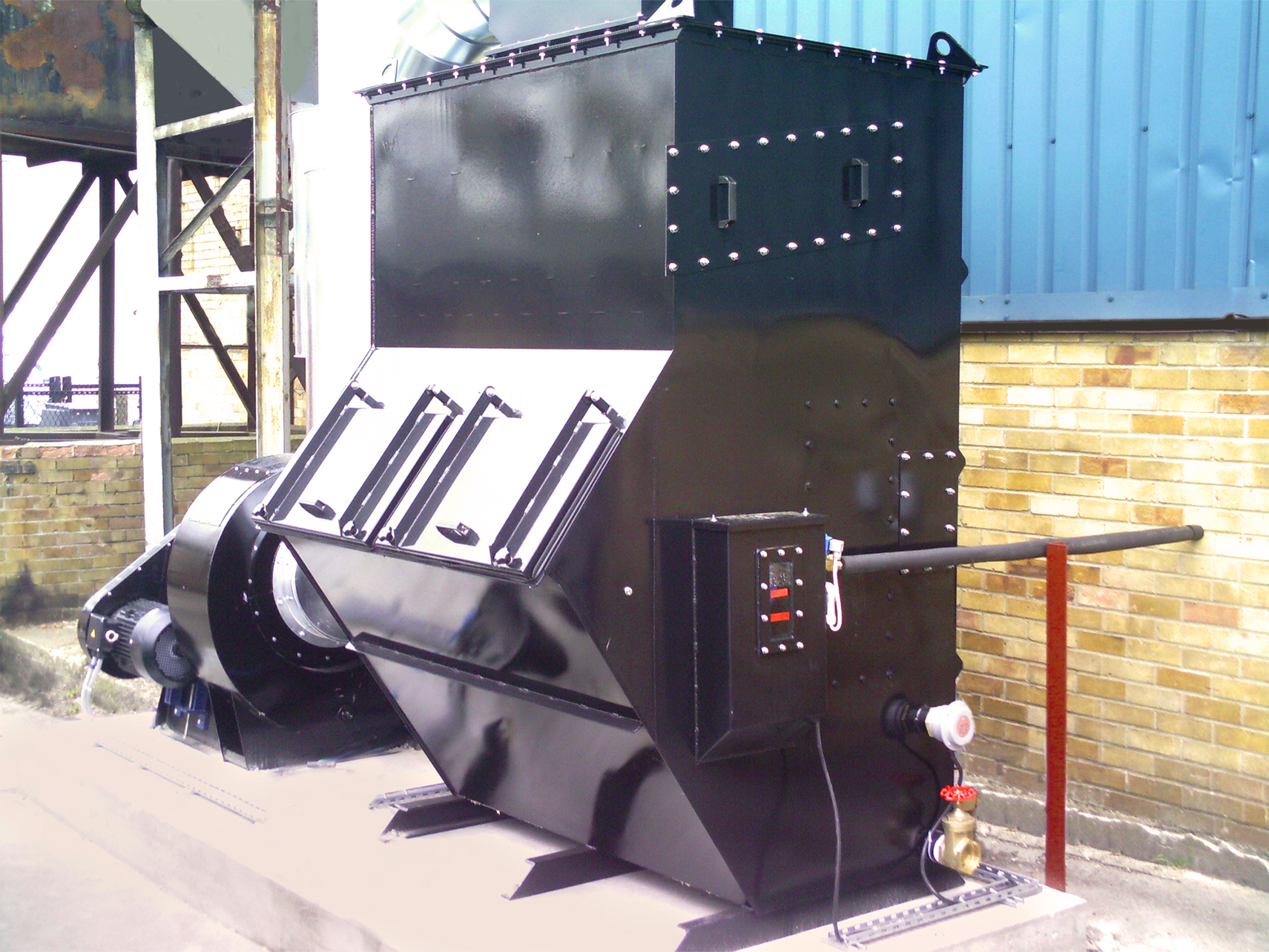
Workshop evolution & waste. Finally, our customers’ businesses grow. They buy a new, high-output CNC, and their old ductwork can’t cope. Or, they are producing a literal mountain of wood waste and paying expensive skip fees to have it hauled away. We act as genuine partners, and design systems that can be scaled as they grow. And for the waste, we partner with a specialised manufacturer of Wood Waste Heaters. This allows us to provide a fully integrated solution, turning their costly disposal problem into free, sustainable heating for their factory.
Ultimately, we’re not just selling a filter. We’re providing a complete, long-term engineering solution that solves their compliance, cost, and operational problems from day one. We build it to last.
How does your team ensure that Dustraction systems meet and exceed regulatory requirements?
That’s a critical point. For us, compliance isn’t just a stamp at the end; it’s the absolute foundation of our ‘Health & Safety First’ value. Our engineering team, led by Chris and Rob, designs from the regulations, not just to them.
While we’ve discussed how we engineer for different dust types, the regulatory side has two specific layers.
For COSHH/LEV, we’ve covered the design, but the key to guaranteeing compliance is that we don’t just ‘design and dump.’ Our own trained site engineers conduct the final commissioning and LEV testing. This creates a closed loop of accountability. The team that designed it and the team that installed it verify that it meets and exceeds the performance standard, handing over a system we know is compliant.
For ATEX and DSEAR, this is where our specialist expertise really matters. Managing explosion risk is a non-negotiable, and our team is trained to conduct these risk assessments. We engineer a complete, safe solution. This means specifying critical, ATEX-certified components, including explosion isolation flap valves. These valves are essential; they are designed to be installed in the ductwork and, in the event of an explosion, they slam shut to prevent the blast from propagating back through the pipes and into the workshop, protecting both people and other machinery. This is a level of detailed, active protection that is fundamental to a safe system.
We stay ahead by being active participants in the industry, not just observers. Our membership in key bodies is vital. We are active members of the Institute of Local Exhaust Ventilation Engineers (ILEVE), the Extraction Manufacturers and Designers Association (EMADA), and the Woodworking Machinery Suppliers Association (WMSA).
This means our engineers are part of the conversation. They are connected to the very experts consulting with the HSE and developing the next generation of best practices. This allows us to be a true partner. We advise our customers on how to future-proof their investment, not just for today’s rules, but for the changes we see coming.
How has Dustraction’s investment in manufacturing capability enabled you to innovate your product range?
That’s a great observation, and that investment is absolutely fundamental to our mission.
The biggest impact is on our bespoke systems. Before, we were limited by what was physically practical to fabricate manually. Now, our in-house manufacturing capability is only limited by our engineers’ imaginations.
Our Contracts Engineers, Chris and Rob, can design an incredibly complex, one-off filter housing, a perfectly optimised fan scroll, or an intricate set of ducting transitions in their CAD software. That digital file then goes directly to our CNC plasma cutter, run by Mick, or our press brakes, operated by JB and Daz.
It means we can manufacture a component to a fraction of a millimetre. We’re not forced to adapt a ‘close-enough’ standard product to fit a customer’s site. We design and build the exact solution they need, which is the very essence of a bespoke system.
Having this technology in-house gives us agility and control. If a customer in the composites or plastics industry comes to us with a new material or a unique machine, we don’t have to wait weeks for a third-party fabricator.
Our team can design, cut, fold, and weld a new solution right here in our Oadby factory. We can prototype and refine our products, like our own centrifugal fans, making continuous improvements. This complete control over our manufacturing process means we can be far more responsive and innovative.
Finally, it’s about quality and sustainability. Our CNC machines ensure every component is perfectly repeatable and built to an exact tolerance. This means tighter seals, more robust structures, and better overall performance.
It also allows us to be more sustainable. We can ‘nest’ parts in the software to get the absolute maximum number of components from a single sheet of steel, which drastically reduces our waste.
Could you describe a recent project?
Yes, a perfect example is our recent project with SAM Mouldings, one of the UK’s leading manufacturers of MDF architectural mouldings. It’s a textbook case of our value proposition in action.
SAM Mouldings is a high-quality, family-run business that is continuously investing in its own facilities. They came to us because they needed to upgrade their existing wood waste extraction system. This wasn’t just a simple replacement. The challenge was twofold:
High volume – The system had to serve multiple, heavy-use machines, including Weinig moulders, beam saws, and CNC routers.
Future-proofing – They are a growing business and explicitly specified that the new solution must be able to handle their future expansion, including extra moulding and sawing capacity.
Our solution
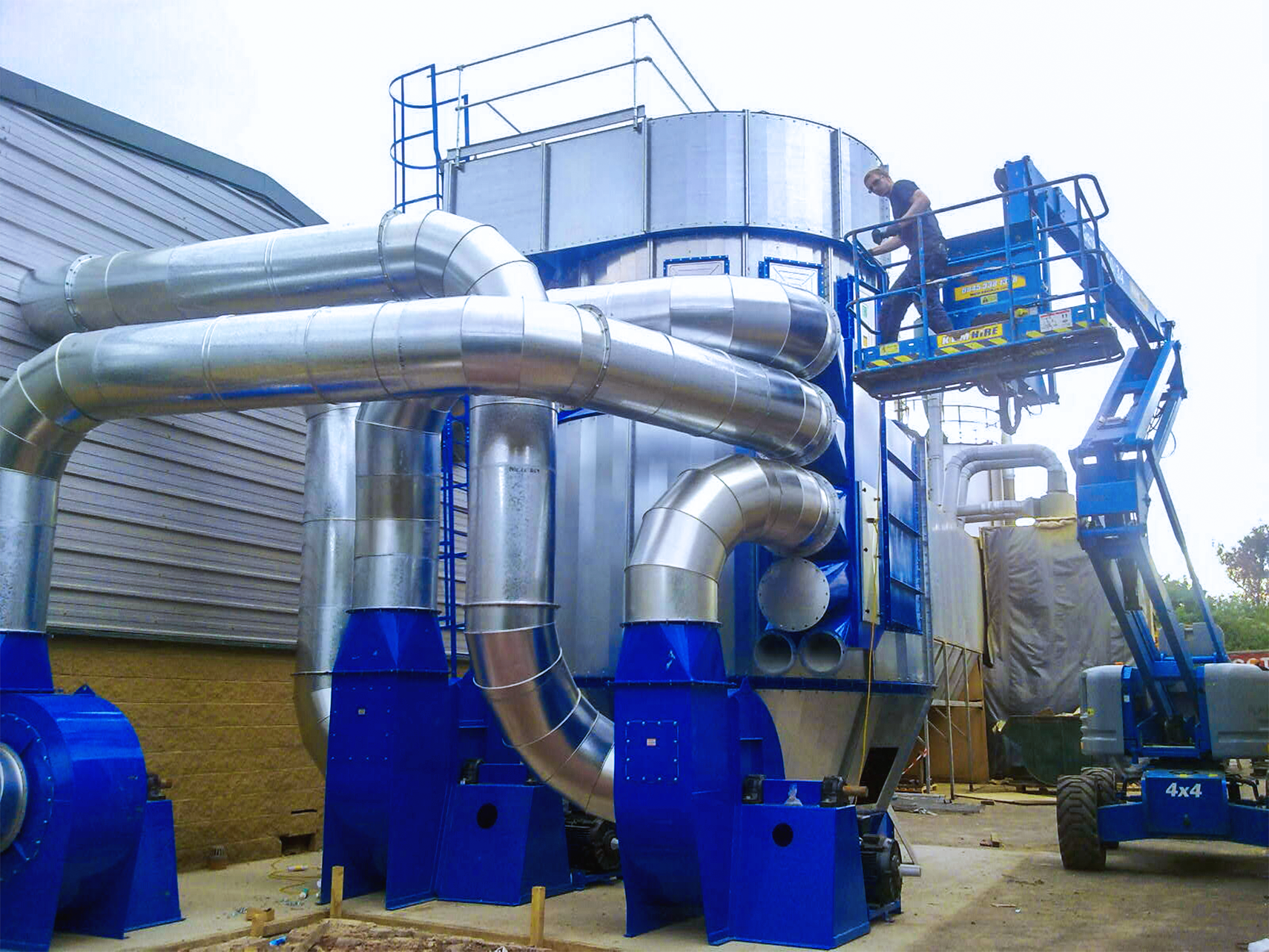
This was a large-scale project. The total air volume required was nearly 76,000 m³/hr, and we engineered the filter with 45% spare capacity built-in to meet their future growth requirement.
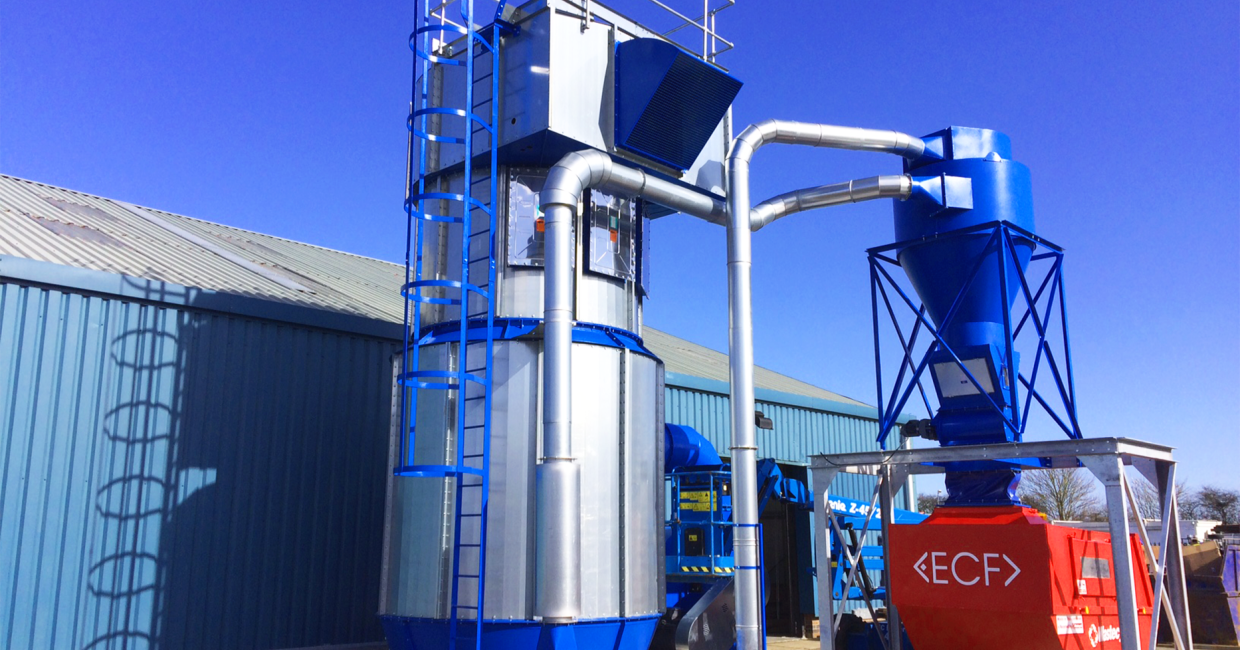
Our solution was a new, externally located Dustrax 4X9 Cyclo-filter.
This is a great piece of robust, British engineering, built from 3mm thick mild steel. It’s a highly efficient design with a two-stage separation. First, the waste-laden air enters tangentially, and 95% of the material is cyclonically separated before it even reaches the filter media.
The remaining 5% of fine dust is caught by the polyester felt filter sleeves. A reverse pulse jet cleaning system, triggered by a pressure drop, keeps the filters clear and allows the system to run continuously.
This two-stage process dramatically reduces the load on the filters, which means far less wear, minimal maintenance, and a longer life.
Finally, we fully integrated the waste discharge from the new filter to feed their existing biomass bunker, helping them turn their wood waste into sustainable energy.
The outcome and feedback
The feedback from their technical director, Mark Kirkpatrick, truly highlights our customer-centric partnership and integrity.
“We have been dealing with Dustraction since 1995 and saw no reason to go to anyone else,” he said. “This trust was built on our unique ‘engineering capability.
“Adding to our decision to return to this trusted supplier was the fact that they were the only company which could handle the high volumes of dust which we create on a daily basis – typically 6-8m3/hr.”
Altogether, the whole operation took three months to complete. From initial design to final manufacturing and commissioning, our on-site team ensured minimal disruption to their operations. All the work was carried out by Dustraction in one unbroken visit, minimising downtime for SAM Mouldings..
What emerging trends do you see in dust extraction or wood waste management?
I see two major trends that are already reshaping our industry.
The first is the move from ‘standard’ to ‘smart’ systems. For decades, a dust extraction system was just a big ‘on/off’ switch. That is no longer good enough. With energy costs being a major factor, the future is in energy efficiency. We’re already engineering systems with variable speed drives (VSDs) and automated dampers that intelligently adjust the fan’s power, drawing air only from the machines that are running.
The next step, which we are actively looking to develop, is IoT integration. This will give workshop managers real-time data on system performance, filter life, and energy consumption, and even send automated alerts when an LEV test is due.
The second trend is an increasing focus from the HSE on total air quality, not just the visible wood chips. The real danger is the fine, carcinogenic dust you can’t see. This means a ‘good enough’ system is no longer acceptable. The technology to meet and prove compliance will become a non-negotiable, driving demand for higher-quality, better-engineered solutions.
What advice would you give to workshop owners who are planning to invest in extraction systems?
For any owner or manager planning an investment, my advice is simple and comes down to three things.
Take a holistic approach and invest in a system, not a product. Please do not just buy the cheapest filter you can find online. A £5,000 filter on a poorly designed, inefficient ducting system will not work. It will fail its LEV test, and you will have wasted your money. You are investing in a bespoke engineering solution for your specific machines, workshop, and workflow.
Plan for tomorrow, not just today. The biggest mistake we see is customers buying a system that is at 100% capacity on day one. What happens in 18 months when you buy that new CNC router? Your entire system is suddenly undersized. As we did with SAM Mouldings, we always advise building in spare capacity. A good partner will ask you about your five-year plan, not just your current machinery list.
Look at the total cost of ownership. The sticker price is only one part of the cost. A cheap, inefficient system will cost you far more over its lifetime in electricity bills, downtime for maintenance, which can lead to failed compliance tests.
A well-designed, energy-efficient system, like those we’ve discussed, might have a higher initial investment but will pay you back every single month in lower running costs and total peace of mind. That’s what our integrity & reliability are all about — providing a solution that is truly Built to Last.