Is manufacturing origin still a reliable measure of industrial quality? For generations, industrial buyers have tended to associate certain manufacturing regions with certain levels of quality.
In machinery, European manufacturers – particularly those from countries with long-established engineering traditions – have built formidable reputations. In wide-belt sanding, that reputation is entirely understandable. Precision, reliability, machine rigidity, sophisticated sanding technology and long-term customer support are critical, and the leading European manufacturers have spent decades developing those capabilities.
But industrial manufacturing is changing. Technology is becoming increasingly international. Components, engineering expertise, automation and manufacturing capability now cross borders routinely. Manufacturers outside the traditional European machinery centres are moving into increasingly sophisticated areas of industrial equipment.
A new force in industrial sanding
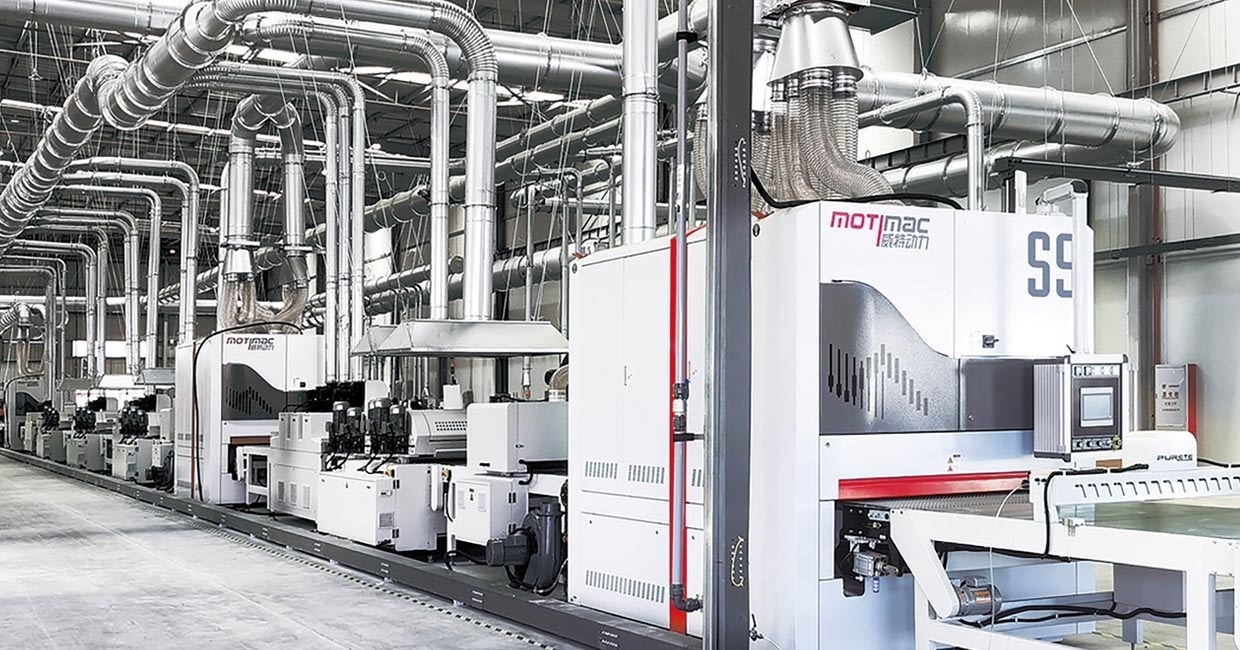
In 2025 Calderbrook Woodworking Machinery introduced the Chinese giant MOTIMAC to the UK and European sanding arena.
Motimac says its sanding-machine research and development began in 2001. The company currently describes itself as having more than 20 years of sanding experience, more than 300 developed models, more than 40 patents, more than 70 employees and more than 60 agents worldwide. It also states that it has supplied 15,000 sanding machines to more than 9,000 customers worldwide.
Sanding is a surprisingly complex process. A wide-belt machine is not simply a motor driving an abrasive belt. Machine rigidity, conveyor stability, belt tracking, pressure control, electronic sensing, sanding-unit design, abrasive selection, dust extraction and the relationship between each sanding unit all influence the final result.
A manufacturer that concentrates heavily on sanding is therefore operating in a very specialised field.
Motimac’s history also records a 2017 research and development cooperation agreement with the Italian company Tagliabue, a famous name of the sanding world of days gone by. This illustrates another feature of modern industrial machinery: manufacturing origin and technology origin are not necessarily the same thing.
Two ranges, one commitment to quality
For UK manufacturers looking to improve sanding quality, consistency and productivity, Calderbrook Woodworking Machinery is putting particular emphasis on two ranges from its Motimac sanding brand: the WT and MT series.
The two ranges address different levels of production requirement but share the same underlying proposition: more controlled sanding, greater repeatability and a stronger return from both machinery and consumables. For Calderbrook, that technology is backed by something equally important — the application knowledge and aftersales support built up over more than three decades in the UK woodworking industry.
Rather than approaching sanding simply as a machine specification exercise, Calderbrook’s focus is on understanding what the customer is producing, what finish is required and where the current process is creating cost, inconsistency or unnecessary manual work. That makes Motimac a natural fit for the company’s service-led approach.
WT: versatility and value
The WT range is positioned as the more versatile of the two platforms, giving manufacturers a modular route into advanced sanding technology across applications including calibration, finishing, veneer and coated surfaces.
At the heart of the segmented-pad models is an 80-section electronic sanding system, with individual sections just 16mm wide. This allows the pad to follow the surface of the panel more closely, helping maintain uniform pressure across flat, slightly warped or variable surfaces and reducing the risk of localised under- or over-sanding.
More than 400 digital scanning points are used to capture the workpiece profile, while Motimac quotes repeated positioning accuracy of up to 0.015mm from its closed-loop positioning system.
For the customer, though, the real benefit is what that technology does in production: greater consistency, less reliance on corrective hand sanding and better control when working with veneers or other sensitive surfaces.
The WT design also addresses operating cost. Motimac says its longer sanding belts reduce change frequency and downtime, while its automatic belt cleaning and air-cooling system can extend abrasive life by 33%.
That combination of intelligence, modularity and adaptability is central to the WT proposition. Motimac itself describes the range as being designed to improve production efficiency, shorten order completion times and deliver higher quality and output.
With operating costs continuing to rise, Calderbrook says customers are looking for a less expensive solution without compromising on quality or reliability.
MT: precision for demanding finishing
Motimac promotes servo technology within the MT range’s sanding systems and has made energy-saving claims for its servo-driven equipment.
Where surface requirements become more demanding, the MT range takes the technology further. The MT segmented-pad machines retain the 80-section electronic sanding system and digital scanning technology but are aimed more directly at high-value and high-precision finishing applications.
Motimac highlights applications including high-gloss, super-matt, skin-touch, brushed and other specialist finishes, alongside a range of painted surfaces. Recipe recall through the control system is intended to make proven settings easier to reproduce from batch to batch.
The machine architecture is built around precision and stability. Motimac specifies fully closed-loop positioning with repeat accuracy of up to 0.015mm, while its control system continuously adjusts the segmented pad according to workpiece data gathered during scanning.
For manufacturers handling high-value veneer or finished components, that repeatability matters. The commercial value is not simply in sanding faster, but in reducing variation, protecting expensive workpieces and ensuring that an established finish can be recreated reliably.
Technology is only half the proposition
For Calderbrook, however, machinery performance is only part of the equation. Sanding results depend on far more than working width and motor power. Substrate, veneer thickness, coating type, abrasive choice, feed speed and the desired surface finish all influence the correct machine configuration.
That is where Calderbrook’s experience becomes particularly important. The company’s role starts with identifying the application and selecting the appropriate solution, but continues through installation, commissioning, training and ongoing support. For customers investing in increasingly sophisticated technology, having that UK-based expertise available before and after installation provides an important level of confidence.
It also reflects the service ethos on which Calderbrook has built its reputation: sell the right machine for the job, make sure the customer can get the best from it and remain involved once it is in production.
As Calderbrook puts it, “You are only as good as your last recommendation.” Responsive, knowledgeable support after installation is therefore key — and must remain available for many years after the sale.
For UK manufacturers, that combination is the real strength of the Motimac proposition through Calderbrook: WT for flexible, intelligent and cost-effective sanding; MT for higher levels of precision and premium finishing; and behind both, an experienced UK machinery partner focused on making the technology work in the real world.
01706 873344
www.woodworkmachinery.co.uk