
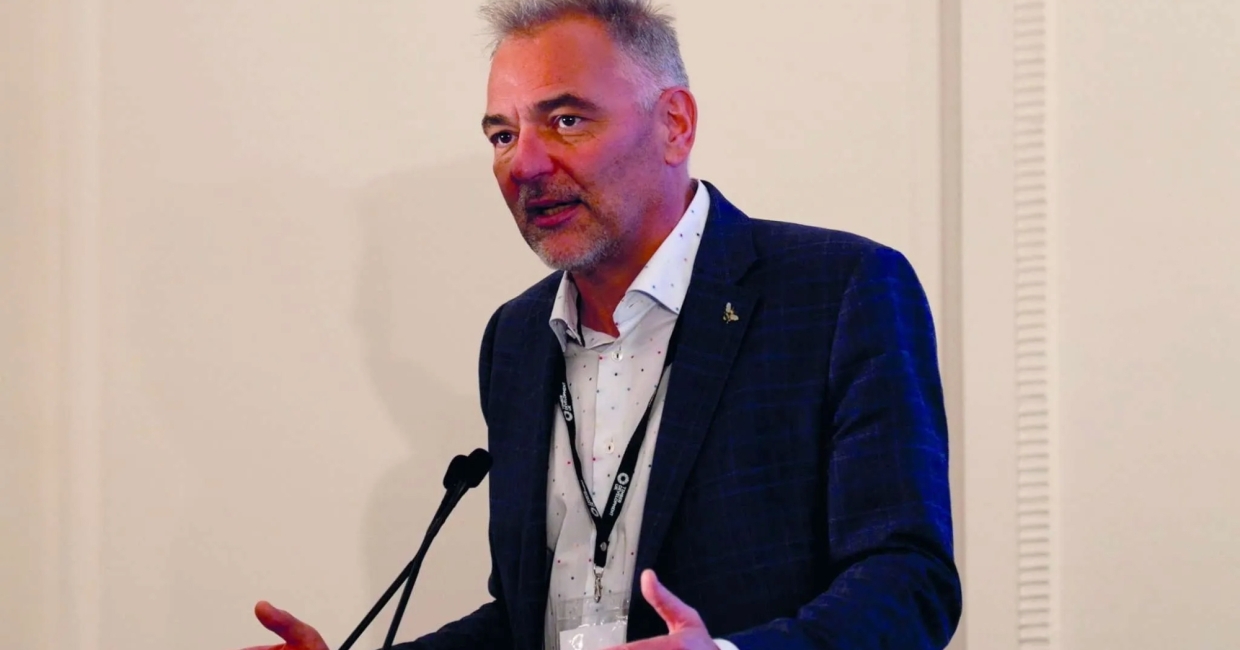
While the timber market may be struggling, there is still plenty of work to be done to put the industry in a stronger position for when conditions improve, said TDUK Chief Executive David Hopkins, as he opened the organisation’s Global Market Conference on 4th November, outlining both the challenges facing the sector and the work TDUK has been doing to support its members.
“We’ve been hit with the same market forces that affect all of your businesses,” he acknowledged, explaining that the organisation had been working to provide support through difficult trading conditions while continuing to invest in its longer-term priorities.
Much of that work centres on three areas: promoting low-carbon construction, encouraging best practice and connecting the timber supply chain with the wider construction industry. These are TDUK’s core objectives, but Hopkins argued that they have become more relevant as businesses look for ways to strengthen their position in an increasingly competitive market.
Hopkins was particularly keen to reinforce the importance of technical knowledge and confidence in timber products.
“We want to lead best practice in the use of timber products, in placing products on the market, [and] in the design, implementation and installation of all the products that you put on the market,” he said.
Training will remain a priority for TDUK during 2027, Hopkins said, with TDUK continuing to expand its Wood Campus learning platform. The resource has already recorded more than 3,000 course enrolments and approximately 2,000 completions, with further modules being developed to support people working across the timber industry.
For merchants and suppliers, the Essentials of Timber Supply courses are particularly relevant, providing practical knowledge about the products those businesses handle and sell. As Hopkins explained, the training modules cover “what they are, where they’re from, how they’re used, how you sell them, how you stock them, and so on”.
Development of Level 3 of the programme is planned for the coming year, alongside further regional training and technical events designed to make learning more accessible to businesses across the country.
Regulation was another major theme of Hopkins’ presentation. TDUK continues to represent the industry in discussions with government covering the Building Safety Act, Approved Document B, the Construction Products Regulation and the EU Deforestation Regulation.
Hopkins’ concern is that poorly considered regulation could prevent timber from being used in building projects where it remains a legitimate and appropriate material choice. The organisation’s role is not simply to respond to new requirements, but to make sure policymakers understand how timber products are used and the consequences that regulatory decisions can have for the supply chain.
The Timber in Construction Roadmap will continue to form part of that work, with plans to reorganise its seven working groups into four more focused groups, creating clearer objectives and stronger engagement with government.
Beyond regulation and training, TDUK plans to increase its promotion of timber in housing, retrofit, landscaping and urban design, building on the growing interest in lower-carbon construction materials.
Hopkins acknowledged that timber frame has been gaining market share in housebuilding, although the wider decline in construction activity means that this progress has not necessarily translated into greater overall demand. The opportunity for the industry will be to maintain that momentum when the market begins to recover.
The industry’s immediate challenges are unlikely to disappear overnight, but the direction outlined by Hopkins was one of continued investment in the things that timber businesses can influence: skills, technical understanding, regulatory representation and relationships with customers.
TDUK’s priority is to make sure the sector is better equipped to compete, not just in the difficult months ahead, but when construction activity eventually begins to improve.