
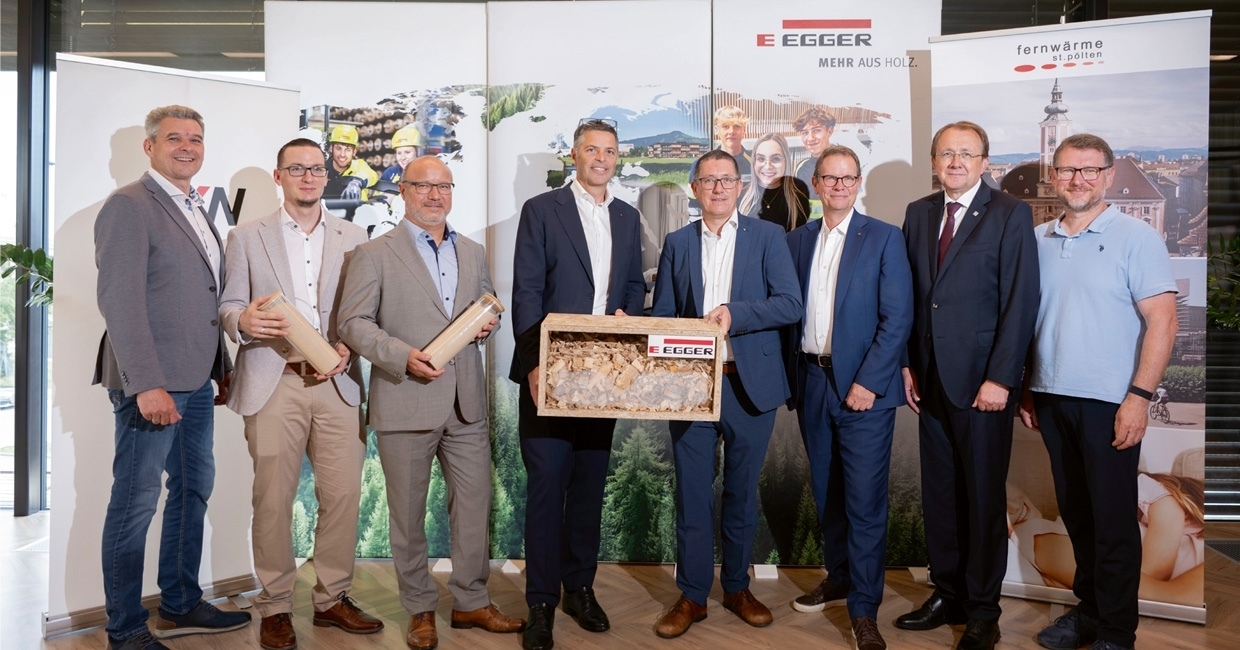
Pictured: The project partners are presenting a forward-looking energy project. (L-R Anton Waxenegger (Managing Director, Fernwärme St. Pölten), Stefan Steigenberger (Project Manager EGGER), Karl Flor (Head of Project Development EVN Wärme), Hannes Mitterweissacher (Chief Technology Officer EGGER), Martin Wurzl (Plant Director Technical/Production EGGER), Stefan Szyszkowitz (Spokesman of the EVN Executive Board), Matthias Stadler (Mayor of St. Pölten), Franz Gruber (Managing Director Fernwärme St. Pölten). © EVN - Matejschek
Together with the energy supplier EVN and the city of St. Pölten, the wood-based material manufacturer EGGER is implementing a project to modernise the energy supply at its plant in Unterradlberg (AT).
EGGER is investing specifically in its local energy infrastructure for this purpose. The positive effects extend beyond the plant boundaries: in future, the plant will be integrated into the city's district heating supply. On 18th June 2026, the project partners signed the heat supply contract, thereby officially setting the starting point for this pioneering project. The first heat delivery is planned for the end of 2027.
"Over the past few years, we have invested massively in renewable energy supply at our plant in several stages," says Martin Wurzl, EGGER Plant Director Technical/Production. "In two biomass power plants, we generate renewable electricity and heat from biogenic fuels for our own processes. We produce at our plant in normal operation without natural gas and are already supplying heat to the neighbouring companies Egger Getränke and Sunpor Kunststoff GmbH. We are pleased that we can now take the next step as part of a comprehensively conceived regional energy concept and will soon be able to supply district heating to the city of St. Pölten."
At the heart of the investment plan is a new steam turbine that will be installed at the EGGER plant in Unterradlberg. It will generate around 4.77 megawatts (MW) of electricity for the EGGER plant from the steam from biomass boiler 1. This will raise the proportion of electricity generated on site to around 87%. The resulting exhaust steam will then be used for district heating. In addition, a new heat pump will feed heat into the district heating network using the turbine exhaust steam from the existing turbine 2 from biomass boiler 2.
The fuels used will be, for example, wood dust from EGGER's own production, wood waste and biogenic production residues that can no longer be used as materials. In total, around 10 MW of hot water are to be delivered into the district heating pipeline during the winter months, which corresponds to around 10% of the heat demand of district heating customers in St. Pölten. It is particularly noteworthy that this additional benefit is achieved without a higher fuel input, meaning the overall efficiency of the energy facilities can be significantly increased. A key advantage: in this way, the use of natural gas in district heating network operations can be further reduced and replaced by heat from renewable energy.
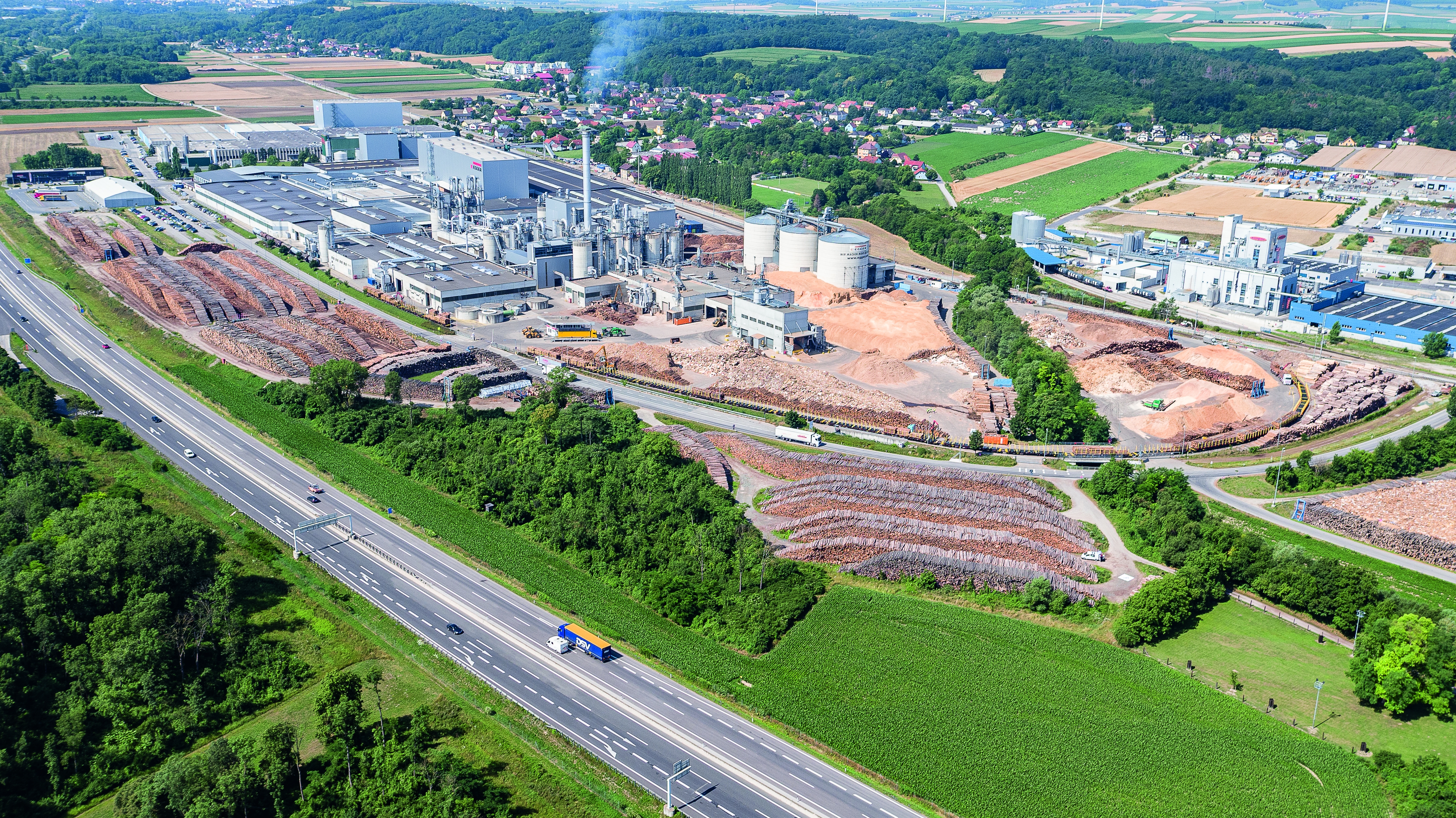
EGGER Holzwerkstoffe
Positioning within EGGER’s climate strategy
EGGER pursues a clearly defined climate strategy with the goal of reducing its climate-impacting greenhouse gas emissions in line with the Paris Climate Agreement. The company is committed to the Net Zero target by 2050. To achieve this, comprehensive measures are being implemented, with a focus on decarbonising the energy supply of its own plants. The development of site-specific energy projects fits into this long-term approach.
The project in Unterradlberg combines numerous positive aspects: more self-generated electricity from renewable sources at the EGGER plant, no additional fuel requirements, more efficient use of existing energy, and connection to the district heating network of the city of St. Pölten. In this way, it makes an important contribution to the future-proof energy supply of the region.
www.egger.com