
Every country that has established itself as a design leader has done so by developing its own distinctive design language. Scandinavia is synonymous with timeless furniture and human-centred simplicity. Italy has become celebrated for its fashion-led approach to interiors and furniture, while Germany has built an international reputation on engineering excellence and industrial-scale manufacturing.
For many years, Ireland has quietly possessed many of the same ingredients for success, yet without a unified identity to present them to the world. We have exceptional makers, world-class manufacturers, extraordinary natural materials and a cultural heritage recognised globally for its richness and authenticity. We have centuries of craftsmanship, architecture, music, literature and storytelling, all shaped by a landscape unlike anywhere else. Yet, despite these remarkable assets, Irish interior manufacturing has rarely been presented through a single, coherent design language.
Kildara was created to change that.
The origins of Kildara
Derived from the ancient Irish Cill Dara, meaning Church of the Oak, the name reflects values that have endured throughout Irish history. The oak has long symbolised strength, wisdom, permanence and craftsmanship – qualities that sit at the heart of the brand. It also reflects a belief that great design should have roots. Every object should have a reason for existing. Every material should have meaning. Every detail should contribute to a larger story.
A shift in perspective
The idea itself emerged unexpectedly during a visit to the Kitchen & Bath Industry Show (KBIS) in Florida earlier this year. Walking through one exhibition after another, there was an undeniable sense that many products, although beautifully manufactured, had become increasingly similar.
As global manufacturing has shifted towards common supply chains and outsourced component production, many interiors have begun to share the same visual language. Products differ only marginally from one another, competing largely on price, efficiency or small improvements in performance. The individuality that once defined craftsmanship has, in many cases, been replaced by repetition.
A conversation with US industry distributor Richelieu helped crystallise what we had been observing. Their advice was remarkably simple: companies should stop trying to be better than everyone else and instead focus on becoming different. Differentiation, not optimisation, creates lasting value.
That conversation stayed with us on the flight home. Rather than asking what Ireland lacked, we began asking a different question. What does Ireland possess that nobody else can replicate?
The answer wasn’t lower manufacturing costs or greater production volumes. It wasn’t trying to become another Italy or another Scandinavia. The answer was Ireland itself. Its people. Its landscapes. Its stories. Its craftsmanship. Its materials. Its culture. Its extraordinary sense of place.
Defining a contemporary Irish aesthetic
Those conversations became the foundations of Kildara - a contemporary Irish design language that manufacturers, designers and craftspeople could collectively build upon.
At its heart, Kildara believes that every product should begin with a story. That story might originate from an ancient landscape, a piece of literature, a song, a craft tradition, an architectural detail or simply a material that has formed part of Irish life for generations. Rather than reproducing history literally, those influences are interpreted through contemporary design, advanced manufacturing and exceptional craftsmanship. It is refined, contemporary and internationally relevant while remaining unmistakably Irish.
Materiality and craftsmanship
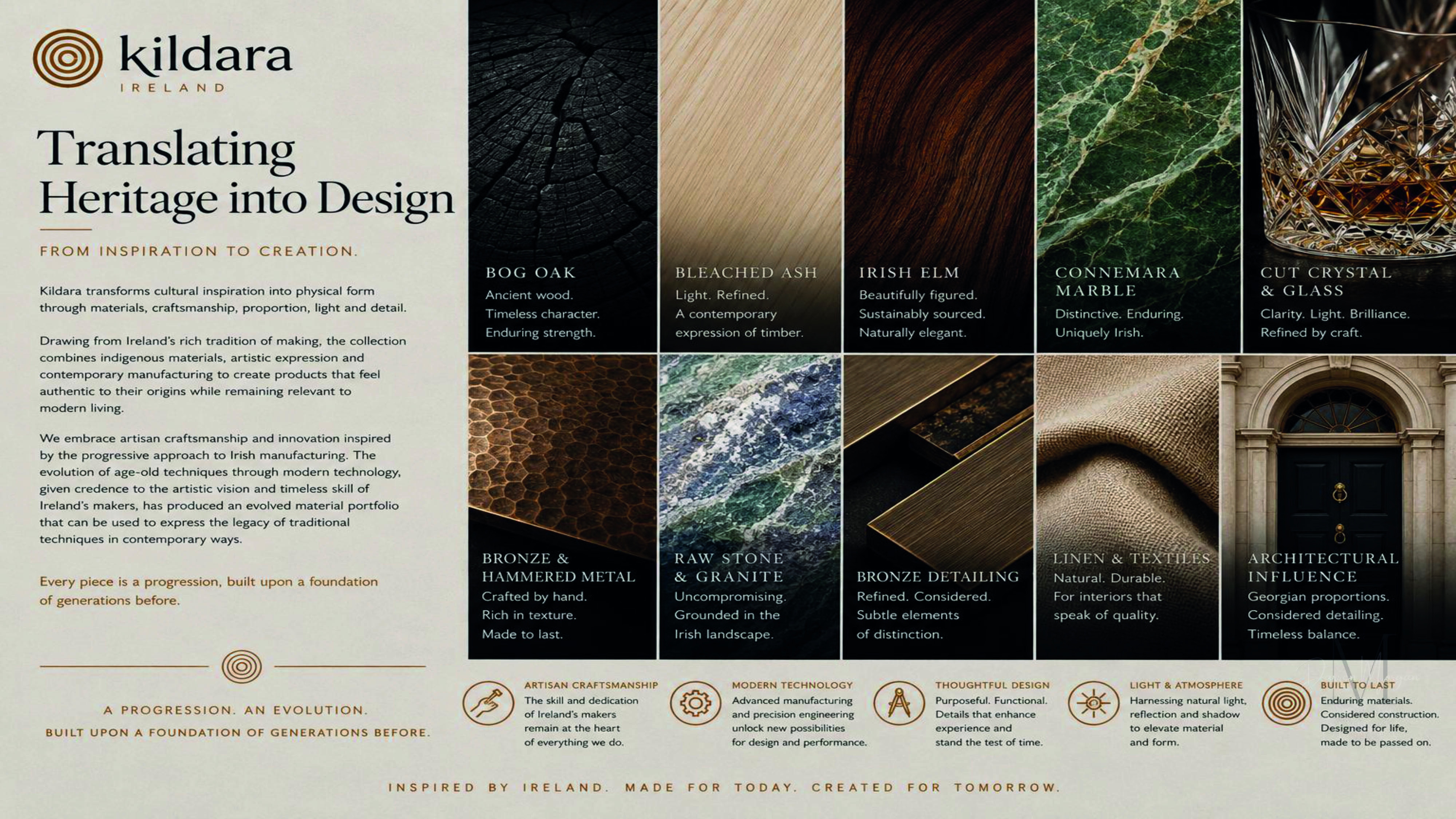
This philosophy influences every design decision. The materials selected are not chosen simply because they are attractive but because they possess an authentic connection to Ireland. Connemara marble, bog oak, Irish ash, elm, Valentia slate, native stone, handcrafted ceramics, woven linens, architectural bronze and decorative glass all become part of a carefully curated material palette that reflects both our landscape and our manufacturing heritage. These materials are then layered together, allowing depth, texture and contrast to become central characteristics of every piece.
Equally important is how those materials are transformed. Traditional craftsmanship sits comfortably alongside precision engineering and modern production technology. Hand-finished bronze detailing, architectural framing, sculptural timber profiles, textured surfaces, precision joinery and layered construction all combine to create products that feel rooted in history without ever feeling historical. Rather than copying the past, Kildara seeks to reinterpret it.
Design in practice
That philosophy is perhaps best illustrated by the work currently being undertaken by Darren Morgan Design, whose creative direction has helped transform an initial business idea into a coherent visual language. Darren’s approach draws inspiration from Ireland’s cultural and physical landscape through proportion, form, materiality and atmosphere.
Ancient passage tombs inspire geometric reliefs. The layered cliffs of Dun Briste in County Mayo influence sculptural forms and construction. Georgian architecture informs proportion and framing, while Ireland’s literary and musical traditions influence the emotional quality of each collection. The references are subtle, but their impact is unmistakable. Heritage is never reproduced. Instead, it is translated into contemporary design.
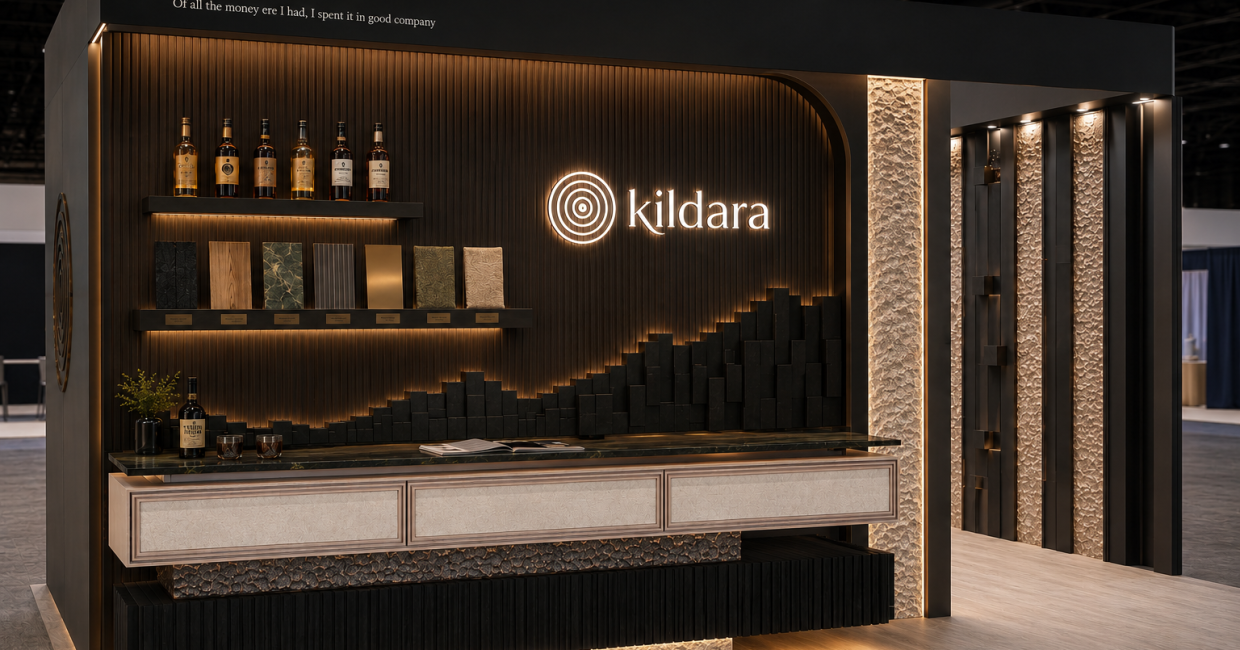
This emerging design language extends well beyond standalone furniture. The inaugural hero piece - a contemporary whiskey console and home bar - was selected because it perfectly embodies Ireland’s traditions of hospitality, craftsmanship and storytelling. Yet it represents only the beginning. Over time, the Kildara language will be expressed through dining tables, kitchen islands, reception desks, hospitality interiors and commercial environments.
Alongside these statement pieces will sit an extensive family of architectural products and components including cabinetry, doors, furniture handles, worktops, decorative wall panelling, textured surfaces, architectural glass, ceramics, textiles, lighting and interior detailing. Whether specified as an individual component or as part of a complete interior scheme, every element will belong to the same coherent family.
An industry-led collaboration
Perhaps the most important aspect of Kildara, however, is that it has never been intended as the product of one company. From the earliest conversations, the ambition has been collaborative. The concept has been shaped by discussions between Gareth Sherry, Eoin Ryan of The Galtee Group, Alan O’Grady of Western Postform, David Smith from TDSG World, whose knowledge of the North American market has provided invaluable commercial insight, Darren Morgan Design, Enterprise Ireland and Atlantic Technological University.
Each conversation has reinforced the same belief, that Ireland already possesses the creativity, manufacturing capability and craftsmanship required to compete internationally. What has been missing is a unifying identity capable of bringing those strengths together. That is precisely what Kildara hopes to become – a platform upon which Irish manufacturers can build products that command premium positioning through authenticity rather than price. A platform that allows businesses to compete through culture, craftsmanship, materiality and storytelling rather than commoditisation. In an increasingly global marketplace, these qualities cannot be easily copied or manufactured elsewhere. They become a genuine competitive advantage.
Looking ahead
The first opportunity to test that hypothesis will come later this year when Kildara’s inaugural collection is presented at the International Woodworking Fair (IWF) in Atlanta before returning home to ArchiExpo in Dublin. These exhibitions will provide an opportunity not only to showcase the first products but also to begin a wider conversation with manufacturers, architects, designers and specifiers about what a contemporary Irish design language might become.
This is only the beginning. Kildara is actively seeking collaboration with manufacturers who possess specialist skills, designers who wish to contribute new ideas, architects and interior designers who believe in creating spaces with meaning, and craftspeople whose expertise deserves a global audience.
Because the ambition extends beyond launching another collection. It is about creating an enduring identity for Irish interior manufacturing. One that celebrates where we come from while confidently designing for where we are going.